

Lot n° 148
Estimation :
4000 - 8000
EUR
LINE & CLAUDE MALESPINE (1914-2005) & (1914-2014) - Lot 148
LINE & CLAUDE MALESPINE (1914-2005) & (1914-2014)
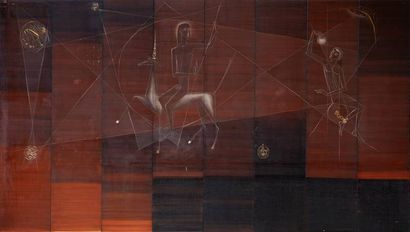
"Le Divin et Le Cosmos" 1956, unique piece created for an apartment in Clermont-Ferrand.
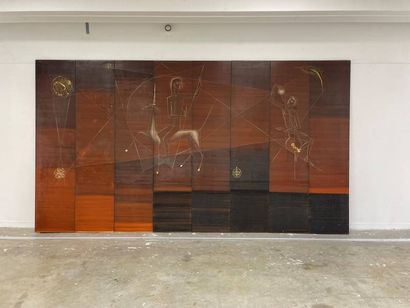
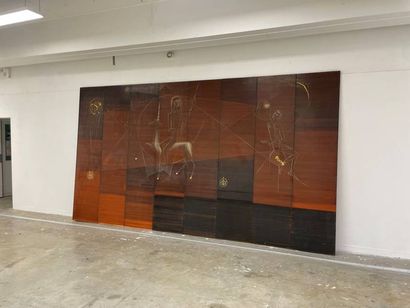
Very important decorative panel in 8 elements forming the title composition.
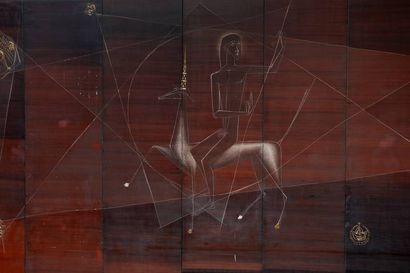
Byzantine] lacquer; engraved and showing zinc white, enriched with silver leaf and gold leaf (for the unicorn's hooves and horn, the signs of the zodiac and various attributes).
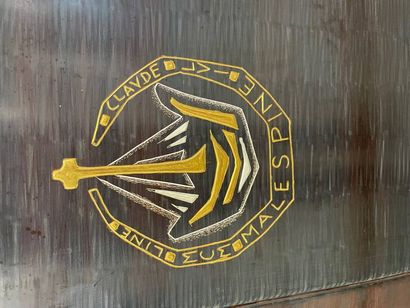
Signed and dated (in Roman numerals) on one of the panels in a cartouche formed by a boat or a mitre Line Claude MALESPINE MCMLVI.
Each leaf: H. 265 cm - W. 60 cm
Panel: H. 265 cm - W. 481 cm
Traces of water drips, various scratches, scattered alterations to the lacquer.
Provenance :
Succession X., Clermont-Ferrand. Created in 1956 for the apartment of the deceased and her husband.
Expert : Emmanuel Eyraud
Line & Claude MALESPINE; between esotericism and spirituality
Line and Claude Malespine, painters whose work was inseparable, formed an artistic couple whose achievements were deeply rooted in the spiritual and the divine1. Trained together at the École Nationale Supérieure des Beaux-Arts in Paris, in the studio of André Devambez (1867-1944), they worked together throughout their lives, creating a body of work that oscillated between figuration and abstraction, and was marked by their respective sensibilities. Driven by a certain spirituality, they took an early interest in religious representations, learning techniques such as tempera and icon writing. Appropriating these age-old crafts, they created a lacquer, known as "Byzantine lacquer", which they used to decorate furniture and screens. Added to their body of work are the many murals they created for churches throughout France, as well as the unique decorations they created for private clients. Some of their creations were exhibited at the various Salons des Artistes Décorateurs of the time, and at the World's Fairs in Brussels and Montreal. Alongside their artistic pursuits, the couple were also keen to pass on their know-how, as evidenced by Claude's appointment in 1952 as director of the École des Beaux-Arts de Clermont-Ferrand, and Line's appointment as a teacher at the same institution.
The decorative panel presented here perfectly illustrates Line and Claude Malespine's artistic explorations of spirituality and esotericism. This important depiction undoubtedly features numerous symbols, inviting an in-depth reading of the work, whose full narrative scope needs to be grasped. Here, astrological signs, motifs borrowed from Christian iconography, geometric tracings, stars and other mystical figures mingle. At the center of this complex composition is a male figure seated on the back of an equine, identifiable by the golden and silver horn atop its forehead as a unicorn. This group of figures is inscribed within a partially traced circle, itself inscribed within a pentagram revealed by multiple intersecting straight lines that structure the entire composition. On the left, the representation continues in a series of circles revealed by a set of diagonals, and within which several astrological signs are represented - we can see the lion, cancer, Aquarius, scorpion and gemini. In response to this celestial configuration, to the right of the panel is a female figure seated on another circle born of this set of straight lines. With her right hand, the figure brushes against a new circle, white and luminous, identifiable with the Moon.
All these motifs take on a new meaning when compared with the symbols of religion and the mystical sciences. Indeed, the male figure dominating the composition could, by virtue of his attributes, be that of Christ. The gesture of his right hand can be identified with the sign of blessing attributed to Christ Pantocrator, or Christ in Glory - the two upraised fingers symbolizing his dual human and divine nature, and the other three, folded, embodying the Trinity. In addition, the halo of light haloing his head would inform of his divine nature; the drawing of a cross on his torso, although integrated into the outline of his figure, would evoke the Holy Cross; finally, his left hand grasping one of the diagonals of the composition would recall his shepherd's crook. At the same time, the unicorn, a fantastic animal that appeared in medieval bestiaries, takes on meanings related to purity, the Virgin and, in some cases, Christ himself. Added to this is the geometrical structure of the composition, in which the circle embodies unity and wholeness, and therefore the divine, and the pentagram symbolizes man - thus inviting the viewer to take a closer look.
My orders
Sale information
Sales conditions
Return to catalogue